
Skip to content
Open 24/7Upfront pricing
Call now 01632 960635
Norwich, Norfolk 01632 960635

Hidden leaks in Norwich homes

Slab leak detection in Norwich for hidden leaks under floors

Warm floors, damp patches, falling boiler pressure or a meter that keeps moving? We find the leak without digging up the whole house.

01632 960635 Call now
  • Leak tracing under solid floors
  • Repiping and re-routing options
  • Written quote before work starts
Request a plumber
How soon do you need help?

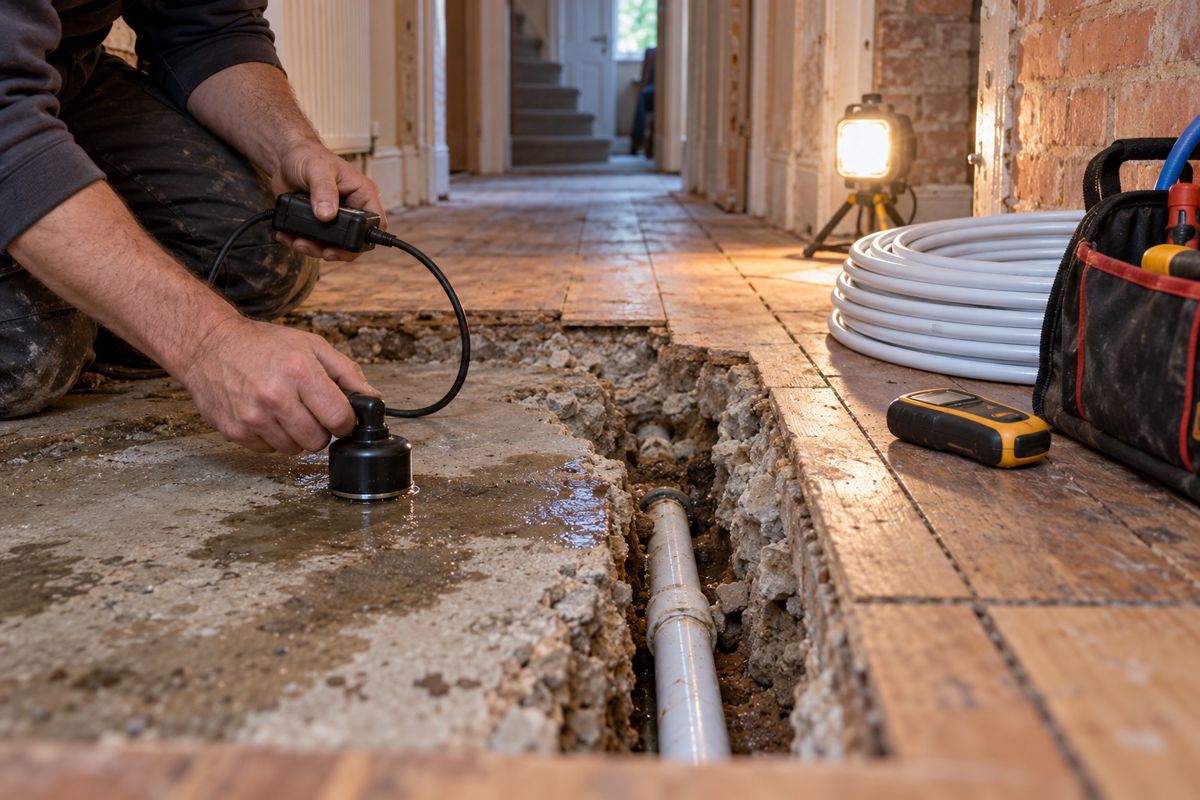
Plumber using a leak detector over an opened solid floor in a hallway

What is a slab leak and how does it show up in a UK home?

A slab leak is a leak in a pipe that runs under or inside a solid concrete floor. In the UK we usually just say a leak under a solid floor, but the term slab leak is common in searches. Many Norwich houses built from the 1930s, and most extensions and conservatories, have concrete ground floors. Water and heating pipes can sit in the screed or beneath it.

Slab leak detection Norwich homeowners need often starts with ordinary signs. Look for a water meter that moves when everything is off, a boiler that keeps losing pressure, a warm patch on the floor, damp or lifting flooring, a musty smell or the sound of running water at night. Our article on the signs of a hidden leak under your floor goes through them in more detail.

How do you find a leak you cannot see?

We narrow the search step by step so that any digging is as small as possible.

  • Pressure tests. We test the cold supply and the heating circuit separately to see which one is losing water.
  • Listening equipment. Acoustic sensors pick up the sound of water escaping through the floor.
  • Thermal imaging. A camera shows warm paths from leaking hot water or heating pipes.
  • Moisture mapping. A meter shows where the damp is strongest.
  • Tracer gas. In some cases, a harmless gas is put into the pipe and detected at the surface.

No single method works every time, so using more than one gives a better chance of finding the exact spot. Once located, only a small area of floor needs opening.

What causes leaks under floors in Norfolk?

The causes are often slow and ordinary.

  • Corrosion. Old copper and steel pipes can pit and fail, particularly in damp screed or sand.
  • Hard water. Norfolk water is hard, and limescale in pipes and fittings shortens their life.
  • Ground movement. Wet winters and dry summers can strain buried joints.
  • Poor original workmanship. Joints made in the screed with no protection can fail after many years.
  • Old lead supply pipes in some older houses, which are worth replacing when the opportunity arises.

Flint-and-brick cottages and Victorian terraces often have a mix of old and new pipework added over generations, which means that more than one pipe may be at the end of its life.

Once the leak is located, the choices are a local repair, re-routing or repiping.

  • Local repair. We open the floor at the leak and replace the damaged section.
  • Re-routing. We run a new pipe along a wall, in a ceiling void or in a duct, and abandon the buried section. It avoids repeat leaks.
  • Repiping. If pipes are failing in several places, new pipework may suit the whole house or a floor.

Price depends on how many leaks there are, access, the type of floor covering, how far pipes must be re-routed, the amount of drying and make-good needed and the type of pipe. Replacing floor coverings may be a separate job. We give a written quote, and a clear explanation of the alternatives.

How long does it take and when should I call?

Finding a leak can take a few hours to a day. A repair may be a day or two. Re-routing a few pipes takes a couple of days, and repiping a whole house may take several. We plan the work around you and cover floors and furniture.

Call as soon as you suspect a leak. Hidden water does not stop by itself, and it can damage floors, walls and the ground beneath a slab. If water is coming through now, close the stopcock and read our emergency plumbing page. If low pressure or no hot water is the main issue, see water heater repair. Our home page lists all our services.

Before we start, check your home insurance. Many policies cover escape of water, and the insurer may want to be told first.

What you can expect

1

Open 24/7

2

Upfront pricing

3

Clear communication

4

Local plumbers

How it works

  1. Call or tap for help

    Tell us what is wrong. We answer around the clock.

  2. Plumber dispatched

    The nearest plumber heads your way with a stocked van.

  3. Fixed with a written price

    You approve the price before any work starts.

How soon do you need help?

Questions about emergency plumber in Norwich

What is the first sign of a leak under a solid floor?

The most common first signs are a higher water bill, a boiler that keeps dropping pressure and a meter that moves with everything switched off. Damp patches, lifting floor coverings, a warm area on the floor or the sound of running water are also typical. One sign alone may be something else, but two or three together suggest a leak.

Will you have to dig up my whole floor?

No. The aim of leak detection is to pinpoint the leak so that only a small area is opened. Pressure tests, acoustic listening and thermal imaging help locate it. Often the best fix is to re-route the pipe above the floor, which avoids digging across the whole room. We explain the options before we begin.

Is a leaking heating pipe different from a cold water leak?

Yes. Heating pipes are part of a sealed circuit, so a leak shows up as falling boiler pressure and a need to keep topping up. Cold supply leaks tend to show on the water meter and the bill. We test each circuit separately to find which one is leaking and where.

What is repiping and do I need it?

Repiping means replacing old pipework with new pipe, either partly or across the whole house. It makes sense when pipes are corroded, have leaked more than once or include lead. A single leak does not always mean full repiping. We will explain what the pipes are like and what makes sense, and give a written quote.

Will my insurance pay for leak detection?

Many home insurance policies cover the cost of finding an escape of water and some of the resulting damage, but terms vary and some exclude gradual leaks or the pipe itself. Read your policy and tell your insurer before work starts. Keep photographs, dates and invoices. We can give you a written report of what we found.

Ready when you are. Call now or request a quote online.

Call now